

When I was seven years old I went into my Mother’s room and burst into tears. “Mom, I don’t want to go to school anymore,” I said to her.
My childhood mind — haunted by the constant deadlines, homework and future dread of having to repeat this endless weekly cycle, in a work place environment, was unable to handle the reality of which we live. A stream of capital and productivity was demanded of our bodies.
After my mother’s unsatisfying response, I retreated back into my room and cried into my bed. I cried so much that I realized that I forgot something very important. Something that is seemingly with us since before our birth and continues after we die.
Something W-O-N-D-E-R-F-U-L
A Life That Requires No Effort
Effort and work are valued greatly in our society. They are seen as shining beacons of a well-tempered citizen in our collective endeavor of progress and stability. For certain, anyone can see why these things are positive and meaningful in our lives. Yet, the words themselves equally create a sense of negativity in us. A sense of stress, pain, and endless time-bound boredom.
After experiencing a boundless mystical bliss when I was seven years old, I somehow knew that my life could always be operated in this way. While, work and effort is something that can be fun for a lot of people, the way we go about it, almost always leads us towards mental health instability, stress, disease, and an overall unsatisfactory life. This is why, I usually talk about these things in the negative. For work and effort are always needed, the way we go about it now, is often overdone and energy is wasted on the act itself instead of the reason for the act. Which is, of course, to generate more happiness, pleasure, and overall wellness in ourselves, which naturally extends to those we are interact with.
Eventually, I found metaphysical knowledge, philosophy and what is often termed as “spirituality’. Which I have found to be a kind of taming of the mind, into a constant sense of feeling good and transmuting the circumstances that make us feel bad.
Many of these books centered around the idea of feeling good no matter the circumstances. Taking action only when it feels good to do so, and relaxing into the existence as it currently is. Reading these words felt great, but they seem to never address the need for work in the real world. It always seemed that these spiritual books were missing something important. As though homelessness wasn’t a reality.
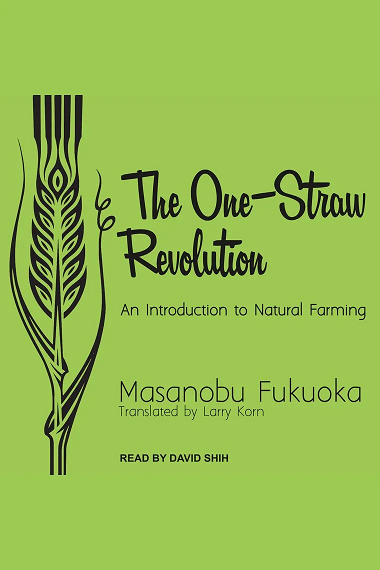
After some time I came across a book that had that missing piece. It was titled “The One-Straw Revolution” by Masanobu Fukuoka, a Japanese farmer who desired to do the least amount of work possible, while still maximizing productivity. His agriculture solutions proved, to me, that some type of effective laziness was possible. A way to work only when one desired to. Not an ounce more of energy needed.
Reading Taoist and Zen literature also provides the same type of sentiment, such as this quote from Chuang Tzu:
You have only to rest in inaction and things will transform themselves. Smash your form and body, spit out hearing and eyesight, forget you are a thing among other things, and you may join in great unity with the deep and boundless.” — Chuang Tzu
This type of inaction is where things get done without much effort at all. No energy is lost in confused thought or actions from anxiety. Things seem to flow like a stream to an open pond.
Our society reflects the opposite of this feeling. It reflects a world of constant endeavor and concern with time. So how can anyone possibly achieve this state that Chuang Tzu speaks about?
The Paradox of Our Joy
Our society is in constant motion, and demands our constant flow of productivity to sustain itself. The key is to somehow find yourself off the hamster wheel, and yet let it ride some form of perpetual motion as it spins by its own accord.
Positive thought and imagination is one small way to endeavor towards this potential. Yet, beyond the idea is to let go of the mind altogether. As Chuang Tzu (and other mystics) have said, to “forget you are a thing”.
In this, it doesn’t quite matter what happens to you. Everything seems to work out for your happiness and effort is self-generated through the same idea. You forget you are even doing it. Situations, people and events seem to line up for your benefit, so long as you have a small trust within the universe to assist your needs.
Though our society, has titled itself towards the axis of effort, it is usually a good idea to balance this by swinging towards its opposite in a type of relaxed aloofness. The challenge is, of course, trusting that it can even work that way. With all the concerns of paying our bills and the rest of the world’s complexity, it is no wonder that an effortless possibility is often glazed over as nonsense and unrealistic.
However, that trust is the only thing that can begin a change within our consciousness. The individual shifting to alter one small part of the collective, as the collective begins to alter with the individual’s new attitude towards the world.
Already, we see more and more people finding ways to work more for themselves than for another. Making due by moving in with friends or family or other arrangements. This may be the temporary solution for society to realize that it can’t keep squeezing the lifeblood out of everyone forever. Eventually, we will realize that in order to sustain our society, we must allocate resources to those in need, on a basis of trust and mutual understanding, and build our institutions with nature instead of against it.
There may be radical shifts in this direction due to people’s synchronization with these lofty ideas. Perhaps, it is you who can help bring it about. Though, no matter how quickly we wish to get there, our destination will be an inevitable result of our own individual’s will to feel good about our growth towards a joyous effortlessness.
 Mystical Transmissions